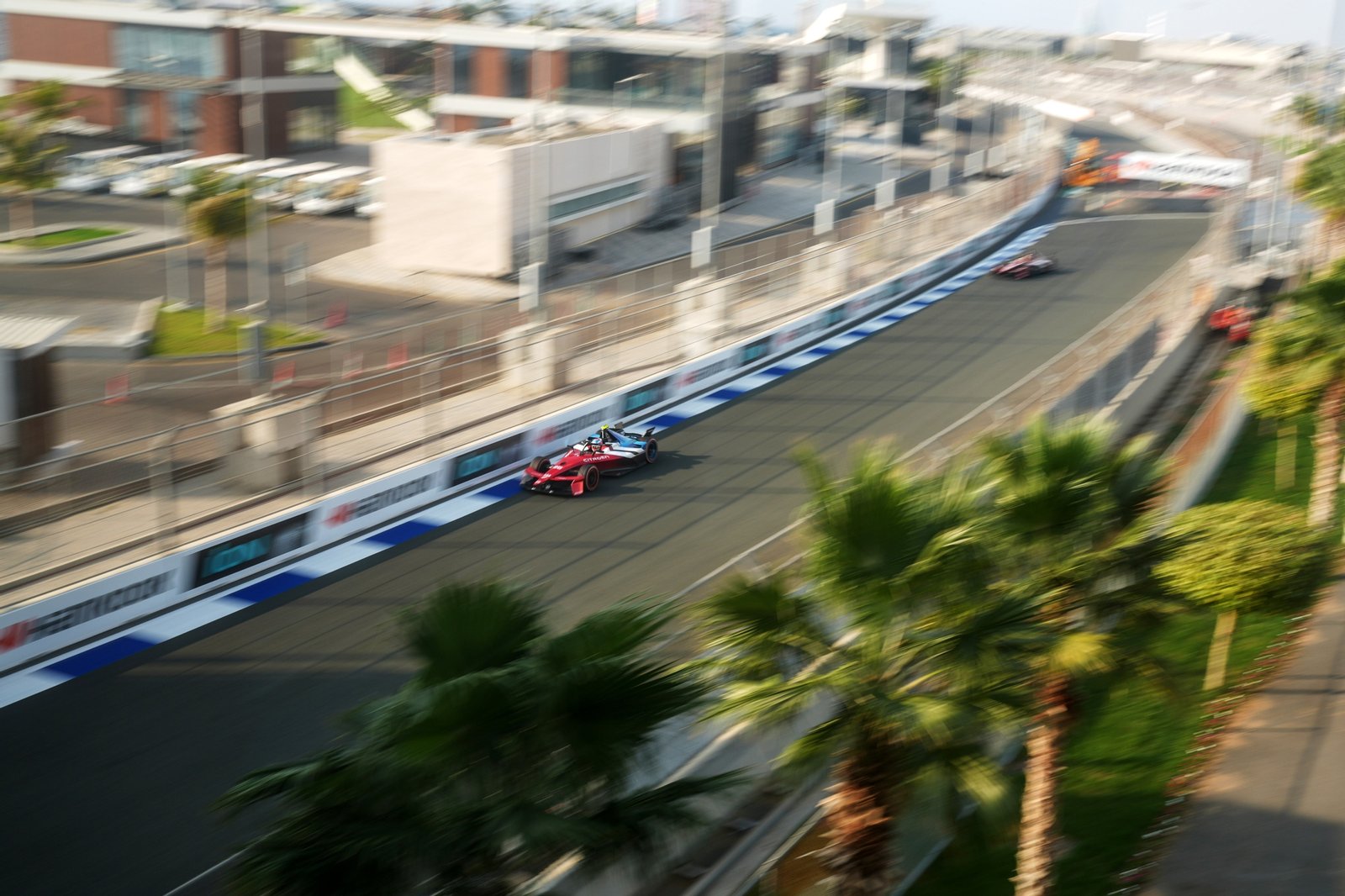
Formula E’s plan to launch its Gen4 era under the lights in Jeddah on Dec. 18-19 is in serious jeopardy after a week of Houthi missile and drone strikes on Saudi airports led Britain to warn its citizens away from the city.
The U.K. Foreign, Commonwealth & Development Office added Jeddah and Dammam at 10:11 p.m. Sunday to the places in Saudi Arabia it advises against visiting except for essential travel. The update also covers every airport in the kingdom except Medina International.
The FCDO warns that travelling against its advice can invalidate insurance. Formula E Operations, the championship’s organiser, is based in London, as are several of its teams. A host government can guarantee security at a venue, but it has no say over a British team’s insurance policy.
Houthi forces in Yemen hit King Khalid International Airport in Riyadh repeatedly between Oct. 6 and Oct. 11, and also struck airports at Abha and Dammam. About 20 people were killed and more than 350 injured, according to figures compiled from Saudi official statements.
A single missile on Oct. 10 hit the terminal complex in Riyadh, killing 12 people; a 13th died the next day. Two days earlier, a strike on the same airport killed Capt. Hamoud Ali Alkalthami, a pilot for Saudia, Formula E’s official airline partner.
The Riyadh airport is closed until at least Oct. 17 under a notice to air crews. The Houthis have warned airlines against using any Saudi airport, and the U.S. State Department now requires its own staff in the kingdom to get special authorisation before using the Riyadh airport.
Jeddah was not struck in this sequence. The city lies about 850 kilometres west of Riyadh, but the FCDO lists it among locations where airports and energy facilities face a heightened threat.
The circuit has been close to this conflict before. In March 2022, a Houthi strike set fire to an Aramco fuel depot a few miles from the track during Formula One practice. F1 raced that weekend after drivers met for hours and Saudi officials gave security assurances.
Four years ago, the decision to race was made in the paddock. This time it will be shaped by corporate risk managers and insurers working from their home governments’ advice.
The World Rally Championship has already been through that sequence in Saudi Arabia. The FIA removed Rally Saudi Arabia, due around Jeddah on Nov. 11-14, from the 2026 calendar on Sept. 17 after Toyota and Hyundai said company safety policies barred their staff from travelling. The FIA said in its announcement that the kingdom remained ready to host.
Formula E’s grid is built largely around manufacturer programmes with similar duty-of-care rules. That puts the British advisory at the centre of the series’ planning, whatever assurances Saudi organisers can offer.
The advisory has also proved changeable. A public record of edits to the FCDO’s Saudi page shows revisions on at least 10 dates since mid-March. Riyadh province went under an all-but-essential warning on March 17, came off it on June 18 and is back under it now.
That record explains why Formula E has held its position. Advice that tightened over a weekend could relax as quickly, and calling off the race early would give up any chance of that.
The calendar limits how long the series can wait. Pre-season testing runs at the Circuito de Madrid Jarama on Nov. 16-20, and equipment leaving that test must go either to Jeddah or to Mexico City, the next round, on Jan. 16. As of Tuesday, that leaves 38 days until testing ends and 66 until the first race in Jeddah.
Formula E’s leadership has held the same line since summer. CEO Jeff Dodds said in August that he had “very high confidence” the Jeddah races would run and that the season would otherwise start in Mexico City.
Dodds also said any postponement would be “a joint decision between ourselves and the Kingdom of Saudi Arabia,” and that the series would not look for a replacement venue in December. Co-founder Alberto Longo, the chief championship officer, said in a Sept. 17 statement that safety was “always our top priority” and that preparations at the circuit were continuing.
Formula E has worked around Saudi travel restrictions before. In February 2021, days before the Diriyah opener, the kingdom closed its borders to travellers from 20 countries, including Britain and the United States. The series won an exemption, teams chartered flights from Britain and Germany, and the races went ahead.
That precedent offers limited comfort. In 2021 the barrier was a Saudi rule, which a Saudi waiver could lift. The current barrier comes from the teams’ home governments, beyond Riyadh’s reach.
Formula One will face the same question first. F1 is due in Qatar on Nov. 29 and Abu Dhabi on Dec. 6, and CEO Stefano Domenicali said Oct. 3 that “the calendar is confirmed.” Its final decision on those races will show how far championships are prepared to go in the Gulf this winter, weeks before Formula E has to commit.
Losing Jeddah would move the Gen4 car’s competitive debut to Mexico City. The car produces 600 kilowatts, about 815 horsepower, and has active all-wheel drive. The record 21-race season would also drop to 19 unless the double-header is rescheduled.
The 2026-27 calendar has an obvious opening. Five weeks separate the Sao Paulo E-Prix on March 13 from Sanya on April 17, and a date in that window would fall after Ramadan, which is expected to end in early March 2027. Using it would still depend on the security situation improving.
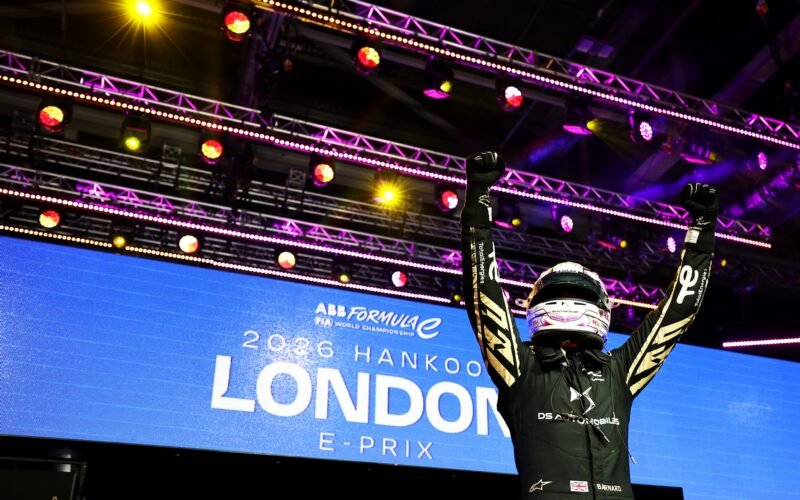
For Saudi Arabia, the stakes reach past one weekend. F1’s Saudi Arabian Grand Prix in April was cancelled, and the WRC round has gone. If December falls too, Formula E’s February visit, when Pascal Wehrlein won the opening race, will have been the Jeddah circuit’s only world championship weekend of 2026.
The kingdom has hosted Formula E since the Diriyah opener in December 2018, and the December double-header was set to be Jeddah’s first as the season’s starting point. Its fate now rests on whether the FCDO removes Jeddah from its warning list before testing ends in Madrid on Nov. 20.