
Mahindra Racing will keep Edoardo Mortara and Nyck de Vries for the 2026-27 Formula E season, the first of the Gen4 era, the team confirmed Tuesday.
Few in the paddock expected anything else. The pair are about to start a fourth season together, and they are coming off the best year in Mahindra’s history: 252 points and third in the teams’ championship.
The car is a different matter. Mahindra was the last of the six Gen4 manufacturers to commit and the last to run its car. The last time Formula E changed its rules, the team spent two seasons at the back of the grid.
Why the drivers stayed
Mahindra’s recent results are almost entirely the work of this pairing. Across three seasons together, they have won two races, added 10 more podiums and taken six poles for the team.
Most of that came in 2025-26: both wins, seven podiums and five poles. De Vries won in Monaco in May and Tokyo in July, ending a drought for both drivers that dated back to 2022.
Replacing either driver would have meant starting a rules reset with someone who does not know the team’s engineers or methods. Team principal and CEO Frederic Bertrand spent the summer saying he wanted stability. On Tuesday he credited the pair with building “trust, shared reference points and a strong way of working together.”
The pair also bring rare mileage. Mortara made his debut at the 2017 Hong Kong E-Prix, in the last season of the Gen1 car, and starts his 10th season. He is one of four drivers on the confirmed grid who will have raced every generation of Formula E car, alongside Jean-Éric Vergne, António Félix da Costa and Mitch Evans.
De Vries, 31, won the 2020-21 title in his second season and returns for his seventh campaign with six wins.
Mortara did not play down the task, calling the coming year “a real challenge, especially on the technical side.”
A familiar position
Mahindra’s last rules change is the reason its Gen4 timeline draws scrutiny.
The team began the Gen3 era in 2022-23 in turmoil. Long-serving team principal Dilbagh Gill left in September 2022, weeks before the season, and Bertrand arrived from the FIA to replace him. A testing crash at Mallory Park and a shortage of battery units had already set back the M9Electro, which proved one of the slowest powertrains on the grid.
Oliver Rowland, who went on to win the 2024-25 title with Nissan, left midway through that season. Lucas di Grassi followed despite a contract for 2024. Mahindra finished 10th in the teams’ standings two years running.
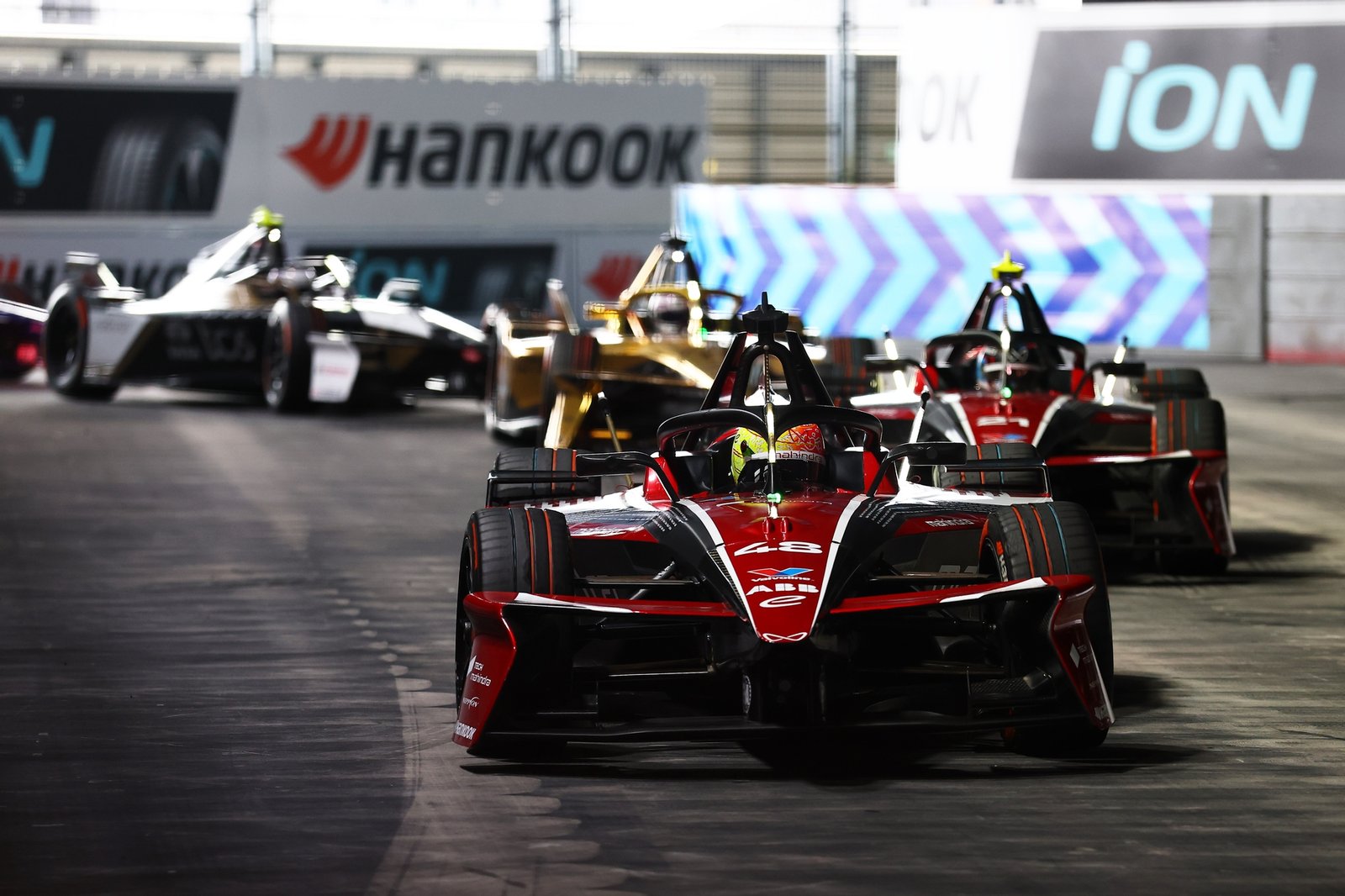
The recovery came from within. Bertrand reviewed the whole operation and ended the powertrain partnership with ZF. The M11Electro lifted Mahindra to fourth in 2024-25, and the M12Electro took it to third last season.
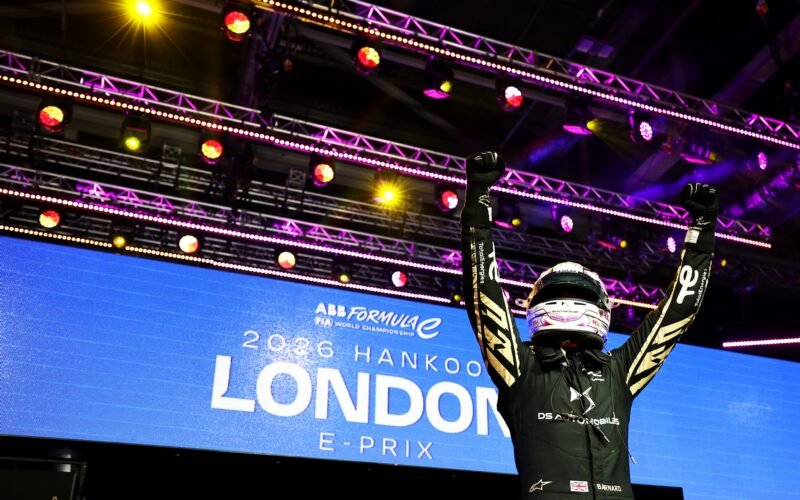
The bookends of the era tell the story. Mahindra took the first pole of Gen3, with di Grassi in Mexico City in January 2023, and the last, with de Vries in London this August. That weekend the team locked out the front row and finished second and third.
In between were two lost seasons. Mahindra only became competitive once the regulations were more than halfway through their life.
Late again?
This time the problem is timing.
The FIA’s deadline for Gen4 manufacturer registration was Dec. 31, 2024. Mahindra let it pass while the company debated whether to keep building its own powertrain or buy one. The board in Mumbai approved a works programme only in November 2025, when Mahindra committed to the series through 2030. The improved results of 2024-25 helped make the case.
By then, the other five manufacturers had already held their first private Gen4 test at Monteblanco in Spain.
Bertrand conceded in February that Mahindra had “officially pressed the button a bit late.” A planned May debut for the full car slipped. Reserve driver Jake Hughes gave the car its first run in July at Abingdon Airfield in Oxfordshire, and the first full test came Aug. 4.
The arithmetic is stark. Rival manufacturers began running Gen4 hardware in late 2025, giving them close to a year of track work before homologation. Mahindra had about 10 weeks. By the time its car turned a wheel, rivals were thought to have logged four to eight days of testing each.
Could it work out?
Bertrand’s argument is that the gap on paper overstates the gap in reality. “That’s why we started late, [but] we are not late,” he said in February.
The argument has substance. Much powertrain development now happens in simulation long before a car runs, and manufacturers lock in key design decisions a year or more ahead. Mahindra kept working on Gen4 while it waited for the board.
The Gen3 Evo also gave the team a head start in one area. That car drove its front wheels only at race starts, in Attack Mode and in qualifying duels. Gen4 runs all-wheel drive all the time, and Bertrand believes the four-wheel-drive software Mahindra developed for the Evo carries over closely.
Much of the car is also shared. Every team runs the same chassis, battery and Bridgestone tyres, which limits the areas where a late start can hurt.
Bertrand has named the one scenario that would break the plan. “The only risk would be if we have a problem with reliability,” he said in July.
Where could it go wrong?
That risk is real. A car that first ran in July has had the least time of any on the grid to reveal its faults, and every day spent fixing reliability is a day not spent on performance.
Gen4 is a bigger step than any previous Formula E car. Race power rises to 450kW, Attack Mode to 600kW and regeneration to 700kW, with a 55kWh battery, permanent all-wheel drive and separate aerodynamic setups for qualifying and racing. More power through more driven wheels creates more ways for a new powertrain to fail.
Homologation raises the stakes. Formula E has historically locked powertrain hardware for two seasons at a time. If the specification Mahindra freezes in October carries a flaw, software can recover some ground. It cannot redesign a motor.
Data is the other weakness. Nissan, Jaguar and Stellantis will each have their powertrains on four cars in 2026-27, and Porsche will have at least four, although it still seems likely that they will have six. Mahindra has no customer team and will run two, as it did through its Gen3 recovery, when Bertrand acknowledged that twice as many cars would probably have made the team faster.
The causes of the Gen3 collapse, a leadership vacuum and a supplier deal that was not delivering, have been fixed. Arriving at the first race with less running than everyone else has not.
The driver factor
This is where continuity pays. Early in a new era nobody fully understands the cars, and a team learns fastest when its drivers and engineers already speak the same language. Mortara and de Vries have had three years to calibrate their feedback, and Mortara was still in mathematical title contention going into the final weekend of last season.
The pairing has costs. Mortara turns 40 in January. De Vries splits his year with Toyota in the World Endurance Championship, where he won Le Mans this year.
Formula E moved Monaco to May 1-2 to clear a clash with the 6 Hours of Spa. That leaves drivers in both series facing three race weekends in a row across Monaco, Berlin and Spa, and one Formula E–WEC overlap remains on the 2027 calendar.
Both drivers also built their reference points in Gen3 cars. A newcomer can sometimes adapt faster to a car that behaves differently, though with this much experience the risk is small.
A tougher grid
Mahindra’s third place came against a strong field, and that field has grown stronger. Porsche, whose Pascal Wehrlein won last season’s drivers’ title, has run Gen4 hardware since late 2025.
Stellantis now fields two teams: Citroën with Vergne and Nick Cassidy, and Opel with Evans and newcomer Théo Pourchaire. Nissan kept Rowland and now supplies Andretti. Jaguar has da Costa.
All of them ran Gen4 hardware months before Mahindra.
The calendar offers some relief. At 21 races, the longest season in the championship’s history gives a slow starter room to recover, and under Bertrand the team has shown it improves quickly once it understands a car.
Verdict
Is Mahindra destined to play catch-up again? Not for the whole era. The team that starts Gen4 is better led and better equipped than the one that started Gen3, and it has a settled line-up. Bertrand’s belief that a late start need not mean a slow car is reasonable.
It is also unproven, and every measurable indicator points the same way: later commitment, later running, fewer test days and fewer cars. The one risk Bertrand has named, reliability, is the one a late car is most exposed to.
The likeliest outcome is a midfield start, with flashes from two drivers who can extract the most from a car, and a clearer picture once in-season software development takes hold.
The first real evidence comes at the pre-season test at Jarama, near Madrid, on Nov. 16-20, before the season opens in Jeddah on Dec. 18-19. If the car runs cleanly there, the catch-up story could be short. If not, Gen4 may start the way Gen3 did.