Two races in. Twelve points on the board. Eighty-six adrift of Mercedes. The start of the season has certainly not been the great success that Red Bull would have been hoping for going into it. And by all accounts, the second race in Shanghai was far worse than the first.
Max Verstappen started eighth (effectively sixth) in Sunday’s Grand Prix, dropped to sixteenth off the line, recovered into the lower reaches of the top ten before getting unlucky with safety car timing, then climbing back up into sixth before retiring with an ERS coolant failure. His team-mate, Isack Hadjar, started ninth, spun off on the opening lap, rejoined, battled through traffic to eighth, and described his points finish as fortunate rather than earned. That was Red Bull’s Chinese Grand Prix in full. Mercedes won a one-two with a Kimi Antonelli claiming his first career victory. Ferrari was on the podium. Haas finished fifth. Red Bull now sits fifth in the Constructors’ Championship, level on points with their own sister team.
So where exactly has it all gone wrong?
The most significant structural change Red Bull made coming into this era was losing Honda and building their own engine. It sounds straightforward when written plainly, but the scale of that undertaking cannot be overstated. Red Bull Powertrains was formed in 2021. By January 2026, they had produced the DM01, named in honour of the late Red Bull GmbH founder Dietrich Mateschitz, developed in partnership with Ford. That is, in engineering terms, a very short amount of time.
Team principal Laurent Mekies said before the season that developing an in-house power unit for 2026 was like “climbing Everest.” After Australia, he estimated that Red Bull was approximately one second per lap off Mercedes, with roughly half of that gap coming from the power unit alone. The other half, significantly, comes from the chassis. Both halves are problems. One is structural and slow to close. The other, in theory, should be faster to address.
The 2026 regulations removed the MGU-H entirely, making the MGU-K solely responsible for energy recovery and deployment. That is a system that demands new battery architecture, new cooling strategies, and a fundamentally different approach to thermal management. This is precisely where manufacturers with decades of hybrid experience, Mercedes and Ferrari most obviously, hold a natural advantage over a team building from scratch.
The ERS coolant failure that ended Verstappen’s day in Shanghai is a direct symptom of that inexperience. Cooling a much more powerful electrical system, in a smaller, lighter car, in conditions that were not particularly extreme, should not result in a retirement. It did. Red Bull knows why it happened. Whether they can prevent it from recurring in Japan in a fortnight is a more open question.
There was also a pre-season controversy involving the compression ratio of the Red Bull Ford engine. Ferrari, Audi and Honda wrote to the FIA expressing concern that Red Bull, alongside Mercedes, had found a way to operate at a higher effective compression ratio than the regulations intended, exploiting the fact that measurements are only taken at ambient temperature. Red Bull’s power unit chief Ben Hodgkinson described the furore as “a lot of noise about nothing,” and no regulatory change was forthcoming. Whatever advantage, if any, that situation conferred has done little to mask the gap in race conditions.
The power unit deficit is one thing. The chassis problems are, if anything, more alarming because Red Bull has historically been among the best in the world at building aerodynamically efficient cars. In Shanghai, that identity evaporated entirely.
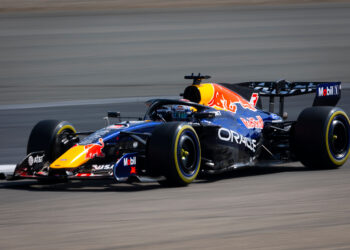
From the opening moments of Friday practice, the RB22 had no grip. Verstappen described a car with no balance, one that fought him every single lap, regardless of what setup changes were tried. “Turned it upside down, it was exactly the same,” he said. “There’s no balance. I cannot lean on the car. Every lap is a fight.” He went on to lament that in previous seasons, throwing the setup at the wall would occasionally reveal something that worked. In China, nothing did.
Telemetry from the race tells a clear story. Red Bull is broadly competitive on the straights, Verstappen even matching Kimi Antonelli’s top speed in some sectors. But in the traction and energy recovery zones, in the slower and medium-speed corners where teams harvest electricity and deploy grip simultaneously, the RB22 is significantly slower than the Mercedes, the Ferrari and even the midfield. Turns 7, 8, 9, 11 and 12 in Shanghai are all areas where the Red Bull loses substantial time compared to the class of the field. These are not isolated circuit characteristics unique to Shanghai. They are a systematic weakness in how the car manages load and energy together.
Red Bull’s chief suspicion is that the problem is at least partly temperature-related, but even that is uncertain. As one account put it, that suspicion is “about as far as it goes.” A team of Red Bull’s resource and experience not being able to diagnose the root cause of a fundamental grip issue after two race weekends is a significant warning sign.
Hadjar’s comment after the sprint race on Saturday summed up the situation with refreshing candour: “We don’t expect to be finding a second, or two seconds, that’s for sure.”
Separate from the core pace issue, Red Bull has also suffered repeated failures at race starts, a problem that has compounded their weekends at every opportunity.
The procedure for launching under the 2026 rules is more complex than before. With the MGU-H gone, drivers must rev the engine much higher for at least ten seconds to spool up the turbocharger, and they must ensure sufficient energy is harvested on the formation lap to produce meaningful acceleration off the line. Verstappen failed to do this in Australia. He failed again in the China Sprint, dropping from eighth to fifteenth before the first corner. He failed again in the race itself, dropping to sixteenth. “As soon as I release the clutch, the engine is not there,” he said after the race. “I just have no power.”
Hadjar, notably, has managed perfectly good starts in the same car. His Melbourne getaway from third on the grid was one of the highlights of the opening weekend before he ultimately retired. This suggests the problem may be as much about software, energy management procedures and driver familiarity as it is about a fundamental hardware flaw. That is actually a faintly encouraging interpretation. Software can be updated. Procedures can be refined. It should not take months to fix a launch problem.
Verstappen has been vocal, forcefully so, about his belief that the 2026 regulations are fundamentally broken. After Shanghai, he called the racing “Mario Kart,” described the rules as “fundamentally flawed,” and said the sport was heading in the wrong direction. He has been saying versions of this since pre-season testing began in Bahrain.
Toto Wolff, with characteristic bluntness, observed that Verstappen’s ire at the regulations and the difficulty of his competitive situation are not entirely unrelated. “Max is really in a horror show,” Wolff said. “When you look at the onboard he had in qualifying, that is just horrendous to drive.” He suggested the criticism is amplified by the fact that Red Bull is suffering more than most.
There is something to that. The battery-dependent, boost-mode racing that Verstappen decries has produced a genuine one-two finish between the two Mercedes drivers in China, with Ferrari close behind. Those results do not suggest a broken formula so much as a formula that has, for now, found its pace hierarchy, and Red Bull is not near the top of it. F1 has decided, with some prudence, to hold off making any major rule changes until at least the Miami Grand Prix in May. A technical working group will convene after Japan to properly evaluate what, if anything, needs adjusting. That is the correct approach. Knee-jerk changes after two races would be premature.
But for Red Bull, the question of whether the regulations are fair is somewhat academic. The regulations are the regulations. Everyone else has to work within them too. The more pressing question is why the RB22 is suffering with them so acutely.
So how long will it take to fix?
There is no comfortable answer here, but there are some distinctions worth drawing.
The start problem should be fixable in the short term. It is a procedural and software issue, and one that Hadjar has already shown is not insurmountable in the same car. Expect some improvement in Suzuka, and more in the gap before Miami.
The chassis balance issues, particularly the temperature sensitivity and the traction zone weakness, are harder. These are fundamental aerodynamic characteristics baked into the design of the RB22. They can be addressed through development, through new floors, new wing configurations, and new suspension settings, but they cannot be reversed quickly. Mekies has indicated that Red Bull planned for an aggressive development rate in the first half of the season. The team now needs to deliver on that intent and do so with a much sharper understanding of why their car lacks grip in the places it does. If they cannot diagnose the problem properly, the upgrades will be guesswork.
The power unit gap is the longest-term concern. Building ERS reliability, improving energy deployment efficiency, and closing the gap to Mercedes in the electrical domain are not months-long tasks. They are years-long ones. Red Bull knew this going in. Mekies essentially said as much. The question is how far behind they fall before the development curve starts to close the gap, and whether that gap proves decisive for Verstappen’s championship ambitions before the season is even half finished.
Red Bull is already 86 points behind Mercedes after two races, sitting fifth in the Constructors’ Championship, one point behind Haas. That is a deficit that, if allowed to grow further in Japan and the sprint weekends that follow, will become very difficult to recover from.
The honest assessment after Shanghai is that some of Red Bull’s problems are fixable in weeks, some in months, and at least one of them is a multi-year project. The team that won 21 of 22 races in 2023 is, right now, scrambling to understand a car that will not behave, powered by an engine they have only just finished building. The gap to the front is real, it is wide, and the road back is going to be longer and harder than anyone in Milton Keynes would like to admit.