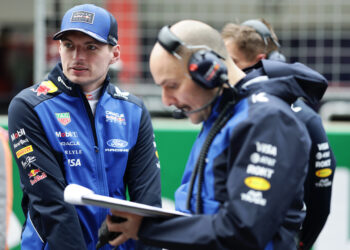
Max Verstappen took a commanding victory at the 2025 Azerbaijan Grand Prix, a race where his calm dominance stood in stark contrast to the chaotic weekend that unfolded for the championship-leading McLaren team. The title fight between teammates Oscar Piastri and Lando Norris took a dramatic turn, with Piastri crashing out on the opening lap and Norris struggling to a frustrating seventh-place finish.
Held on Baku’s notoriously unforgiving street circuit, the 17th round of the championship was marked by high winds, a wild qualifying session, and costly driver errors. Verstappen’s flawless performance has reignited his title hopes, while McLaren was left to ponder a missed opportunity that saw their comfortable championship lead significantly reduced. In a weekend of major storylines, Williams also celebrated a landmark result, with Carlos Sainz taking the team’s first podium finish, in an actual race, since 2017, underscoring the unpredictable nature of Formula 1’s most treacherous street race.
From the moment the cars hit the track on Friday, Baku’s reputation for unpredictability was on full display. Gusting winds of up to 40 km/h made the high-speed sections treacherous. McLaren initially looked set to master the conditions, with Lando Norris topping the timesheets in Free Practice 1. However, the session was not without alarm bells for the Woking-based outfit. Championship leader Oscar Piastri was confined to the garage for 25 minutes with a power unit anomaly, sparking brief fears of a grid penalty on a weekend where both drivers were on the cusp of engine component limits.
The second practice session was heavily disrupted by a mid-session downpour, rendering most of the running meaningless. It was long enough, however, for Norris to clip the wall at Turn 8 and for Alpine’s Pierre Gasly to find the barriers—a grim foreshadowing of the carnage to come.
By Saturday’s final practice, Norris had re-established his dominance, dipping below the 1:42 barrier to set a blistering pace. McLaren seemed to have the edge, their MCL39 seemingly perfectly suited to Baku’s blend of long straights and tight, technical sections. But as the cars lined up for qualifying, the wind picked up to a ferocious 45 km/h, and the sky threatened rain, turning the session into an unprecedented test of survival.
What followed was one of the most chaotic qualifying sessions in recent memory. Lasting one hour and 58 minutes, it was interrupted by a record six red flags as the concrete walls claimed victim after victim. Williams’ Alex Albon was the first to fall in Q1, followed by a catalogue of spins and shunts from Franco Colapinto, Nico Hulkenberg, Ollie Bearman, and Isack Hadjar.
For McLaren, the session that had promised so much unravelled in Q3. With just over three minutes remaining, Piastri, on a flying lap, locked his brakes heading into the tight Turn 3, spearing head-on into the barrier. It was the championship leader’s first major error in a Q3 shootout since Australia, and a devastating blow. Moments later, Ferrari’s Charles Leclerc crashed at Turn 15, triggering the sixth and final red flag. Norris, who had been on a lap destined for the front row with purple sectors, was forced to abort. On his final frantic attempt, a scruffy lap saw him clip the wall at Turn 15, consigning him to a deeply disappointing P7.
When the dust settled, Max Verstappen had secured a brilliant pole position. But the real shock was Carlos Sainz, who placed his Williams on the front row in a stunning display of the team’s straight-line speed prowess. Behind them, the grid was a jumbled mess, with the McLaren title rivals languishing in seventh and ninth, their weekend already on a knife-edge.
The Race
As the five red lights went out on Sunday under sunny but blustery skies, the championship drama ignited instantly. From ninth on the grid, Oscar Piastri’s weekend went from bad to catastrophic. The Australian rolled forward before the lights went out, jumping the start. In a desperate attempt to correct his mistake, he stopped his McLaren, only for the anti-stall system to kick in, causing a bog-slow getaway that dropped him to the very back of the field.
His race would last less than one full lap. Trying to claw back positions through the notoriously tight castle section, Piastri misjudged his braking point into Turn 5. With cold tyres and a gust of wind unsettling the car, he locked the front-left wheel and slid helplessly into the barriers, ending his 34-race finishing streak. It was his first retirement of the season, and as he climbed dejectedly from his wrecked McLaren, the door was thrown wide open for his rivals.
The stewards later investigated Piastri’s jumped start and, despite his retirement, issued a five-second penalty. Under normal circumstances, an unserved penalty can be converted into a grid drop for the following race. However, FIA guidelines clarified this year state that a single, minor five-second penalty will not be converted, meaning Piastri will escape further punishment for the Singapore Grand Prix—a small mercy on a disastrous day.
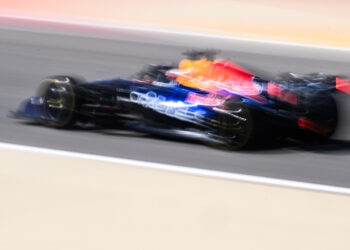
With Piastri out and a Safety Car deployed, the race was Verstappen’s to control. He executed the restart perfectly, leaving Sainz and the chasing pack in his wake. From there, the Dutchman ran a lonely and flawless race, leading every single lap on a conventional one-stop strategy to win by a comfortable 14.6 seconds. It was a serene performance that stood in stark contrast to the frantic battles raging behind him.
The fight for the final podium places provided the most compelling action. Sainz held second in the early stages, but soon found himself under pressure from the Mercedes duo of Kimi Antonelli and George Russell. After a forceful move by Antonelli on his teammate at the start, Mercedes split their strategies. Antonelli pitted early in an attempt to undercut Sainz, but it was Russell’s extended first stint on the hard tyre that proved to be the masterstroke. The “overcut” allowed him to emerge from his pitstop ahead of Sainz, securing a superb second place.
For Williams, however, third place felt like a victory. Sainz expertly fended off late pressure from Antonelli to secure the Grove-based team’s first podium since the controversial 2021 Belgian Grand Prix. It was a landmark moment for a team on the long road back to competitiveness.
Further back, a DRS train formed behind the Red Bull of Yuki Tsunoda, who was having a stellar drive. This train would become the source of immense frustration for Lando Norris.
McLaren
For McLaren, Baku was a brutal lesson in how quickly fortunes can turn in Formula 1. The weekend that could have seen them clinch the Constructors’ Championship instead became their worst performance of the season.
For the unflappable Australian, the weekend was a nightmare of uncharacteristic errors. After a season of metronomic consistency, his composure finally cracked under the relentless pressure of Baku. The qualifying crash was a simple misjudgment, but one that put him on the back foot for the race. The Lap 1 calamity was a cascade of mistakes—the jumped start, the slow getaway, and the final, race-ending lock-up.
“Two simple errors on my behalf,” a dejected Piastri admitted post-race. “I know better than that and to expect the lack of grip. I’m certainly not blaming it on anything else.” While the errors were costly, he took comfort in their rarity, insisting they were easily rectifiable rather than a sign of a deeper issue. “Obviously we’re not going to feel amazing after a weekend like this,” he reflected. “But I would be much more concerned if these errors were because I was trying to make up time.”
With his teammate and title rival in the barrier, Norris was presented with a golden chance to take a huge bite out of Piastri’s 31-point lead. But the race became a story of frustration and missed potential. After being jumped by Leclerc at the Safety Car restart, Norris found himself bottled up, first behind the Ferrari and then, for the majority of the race, behind the Red Bull of Yuki Tsunoda.
Despite having what he believed was a faster car, the turbulent air and potent DRS effect meant he was powerless to pass. A slow pitstop, caused by a delay on the right-front tyre, further compromised his strategy, dropping him behind Liam Lawson and Leclerc. Though he fought his way back past the Ferrari, his progress ended there. He spent the final laps glued to Tsunoda’s gearbox but could find no way through, even attempting a bold move around the outside of Turn 1 on the final lap.
He finished seventh, gaining only six points on Piastri. The championship gap was down to 25, but the result felt like a defeat.
“I don’t think we were bad but I could barely keep up with Tsunoda and there were parts of the track where the Red Bull was just unbelievably fast,” Norris explained, praising his rival’s performance. “The car didn’t fill us with a lot of confidence this weekend. It was on a bit of a knife edge at times.” He acknowledged that if he had started where his pace suggested he should have, “I think I would have finished second,” but conceded, “we didn’t have the pace of Red Bull, honestly. That was very, very clear.”
Elsewhere on the grid, Ferrari’s difficult weekend concluded with a clumsy failed attempt to swap their drivers. Lewis Hamilton, on fresher tyres, had been let past Charles Leclerc to attack the cars ahead. When he couldn’t make progress, the team ordered him to give the position back on the final straight, but a late message and a misjudgment saw Hamilton cross the line just ahead. “That won’t happen again,” a contrite Hamilton said, though Leclerc dismissed the incident’s importance, stating, “For an eighth place, I don’t really care.”
Racing Bulls enjoyed a superb day, with Liam Lawson finishing a career-best fifth after starting third, and rookie Isack Hadjar securing the final point in tenth.
As the F1 circus packs up and leaves the Caspian Sea, the championship picture has been thrillingly redrawn. McLaren’s dominant march has been halted, their vulnerabilities exposed by Baku’s brutal embrace. Lando Norris and Oscar Piastri leave Azerbaijan knowing a massive opportunity was missed, their internal battle now tighter and more tense than ever.
And looming over them both is Max Verstappen. With two consecutive wins, Red Bull has found its form at a crucial stage of the season. While a 69-point gap with seven races to go remains a significant challenge, Verstappen’s flawless drive was a stark reminder that one of the greatest drivers in the sport’s history cannot be counted out. The fight for the 2025 Formula 1 World Championship is far from over; it may have only just begun.