The penultimate day of Formula 1’s final 2026 pre-season test delivered one of the most technically fascinating and narratively rich days of testing in recent memory. Mercedes driver Kimi Antonelli topped the combined timesheets with the fastest lap anyone has managed in a 2026-spec car at the Sakhir circuit, setting a 1:32.803s that edged out Oscar Piastri by just 0.058 seconds. But the headline number almost played second fiddle to the story that had the entire paddock buzzing from first light, which was Ferrari’s sensational, regulations-exploiting, 180-degree flipping rear wing, revealed to the world in the opening laps of Lewis Hamilton’s morning stint.
Throw in an afternoon breakdown for Aston Martin that was painfully familiar, a comprehensive upgrade package from Red Bull that hinted at serious intent, candid admissions from defending champion Lando Norris about McLaren’s current limitations, and a pair of practice start simulations that showed Hamilton leaping from the line better than anyone, and you had a day packed with storylines. With just one day of pre-season testing remaining before the 2026 season opener in Melbourne on March 8, the picture is beginning to crystallise, even if the finer details remain deliberately obscured behind a familiar pre-season wall of obfuscation.
Max Verstappen was first to make an impression on the lap times on Thursday morning, posting a 1:38.955s early in the session on the medium compound Pirellis. George Russell followed, pushing the benchmark down, before Gabriel Bortoleto and then Lando Norris took their turns at the top. The McLaren driver, who is defending his first drivers’ championship this season after clinching the title in 2025, lowered the best time to a 1:35.406s before improving again to a 1:33.453s, which became not only the session benchmark but the fastest lap set across the entire Bahrain testing programme up to that point, shading Russell’s Wednesday reference by just 0.006 seconds.
Verstappen, making his first appearance of the second test after leaving the entire opening day to new teammate Isack Hadjar, improved to 1:33.584s, putting him 0.131s behind Norris in second. George Russell completed the morning third-fastest, having contributed 77 laps during his stint, the highest of any driver during that session and an indication of just how productively Mercedes were working through their programme. Alex Albon was fourth for Williams, with Bortoleto fifth and Oliver Bearman sixth for Haas. Franco Colapinto slotted into seventh for Alpine.
Yet the conversation in the paddock, in the television studios, and across social media was entirely dominated not by lap times but by a piece of engineering so unexpected that, when Sky Sports F1 technical expert Sam Collins first noticed it, he initially thought it might be a mechanical failure. It was not. It was one of the most audacious aerodynamic concepts ever seen in a Formula 1 pre-season test.
When Lewis Hamilton appeared on track in the early minutes of Thursday’s session aboard the SF-26, the rear wing appeared conventional enough to the naked eye. But as he came down the main straight and the active aerodynamics kicked in to reduce drag, something extraordinary happened. Rather than the upper rear wing element simply opening in the conventional fashion, lifting at the trailing edge as most teams’ designs do, the Ferrari’s upper flap rotated a full 180 degrees, ending up completely inverted, running effectively upside-down on the straight.
The concept exploits a significant freedom in the 2026 active aerodynamics regulations. Under the old DRS rules, teams were constrained by a maximum slot gap size of 85mm and a fixed rotational axis. The 2026 rules are far more permissive, specifying how quickly the wing can move but placing no restriction on the final angle or orientation of the wing in its deployed position. With the rotational axis positioned at the leading edge of the upper element, Ferrari’s engineers designed a system that allows the wing to rotate more than 180 degrees, flipping the profile so that the curved surface, which in normal use faces downward to generate downforce, is now facing upward, generating lift rather than downforce on the straight.
The aerodynamic logic is essentially borrowed from aircraft design. A conventional active aero system reduces drag by opening a slot gap, but the wing profile itself still generates some residual downforce, and therefore some residual drag. By fully inverting the wing, Ferrari aims to negate this entirely, creating a net upward force that actively counters the downforce still present from the car’s floor and diffuser at high speed. The practical result, according to data from Hamilton’s runs, was an increase in straight-line speed of approximately 10 km/h compared to rivals’ approaches.
But the more significant benefit, and the one that Ferrari’s own sources have pointed to, is energy saving rather than outright speed. The 2026 regulations introduce a radically different energy deployment philosophy, with the power unit split between a combustion element and a far more powerful electrical element than in previous hybrid eras. Managing the electrical energy budget is critical to competitive lap times. By reducing aerodynamic drag and therefore rolling resistance through corners that lead onto straights, Ferrari’s inverted wing helps the car carry more speed with less electrical deployment, effectively saving the battery for when it is most needed. The wing allows drivers to arrive at the end of a straight with more electrical energy in reserve, which can then be deployed on the next acceleration out of a corner or held back for a crucial overtaking move.
From a purely technical standpoint, this is a brilliant piece of engineering. Ferrari has found a regulatory gap that no other team had exploited, and they have done so in a way that is reportedly impossible to replicate without a fundamental redesign of the entire rear of the car. The mechanism requires a specific hinge architecture and structural packaging that teams with conventional wings simply cannot retrofit. It is not an upgrade in the traditional sense; it is a completely alternative architectural philosophy that Ferrari has built into the SF-26 from the outset.
The question that will be forensically examined before Melbourne is whether the FIA deems it legal. Ferrari has stated that they believe the design complies with the regulations, and the fact that it has been run in public, on camera, without being summoned to the stewards, suggests the team has done its regulatory homework. But the reaction from rival teams was predictably a mixture of admiration and scrutiny, and protests cannot be ruled out if the device proves decisively quick in Australia.
One should be careful about reading the situation through rose-tinted glasses for Ferrari, however. The concept is described as a test item, with no commitment to carry it through the season. The structural and mechanical complexity of a wing that must reliably flip 180 degrees at high speed, lap after lap across a race distance, in varying temperatures and at different circuits, is genuinely significant. Testing it in Bahrain is one thing; trusting it through 24 race weekends is quite another.
For all the excitement surrounding the flip-wing, the morning session was not a comfortable one for Ferrari in operational terms. After completing just five laps, Hamilton’s SF-26 was pulled into the garage, with the team describing the stoppage as an unspecified “issue.” The car’s sidepods were removed, and screens went up in the familiar ritual of a team that wants to hide something mechanical from prying eyes and cameras. Hamilton did return to the circuit at the end of the morning session, but only to participate in practice start trials.
And what practice starts they were. At the end of the morning, four cars lined up for simulated race starts on the main straight, and Hamilton’s getaway was noticeably superior to the rest. McLaren’s Norris, by contrast, appeared to struggle to get off the line cleanly. The second batch of practice starts at the end of the full day’s running, which involved all cars except Aston Martin and Audi, and again, Hamilton’s launch looked the most authoritative, something that will have prompted both excitement inside Ferrari and discomfort inside the garages of his rivals. Getting off the line cleanly under the 2026 regulations, with their complex electrical deployment on the starting phase, appears to be an area where Hamilton and Ferrari have done considerable work. If that advantage is genuine and repeatable, it could be worth considerable tenths in Melbourne.
George Russell’s contribution to the morning session was less dramatic than Ferrari’s technical theatre, but arguably more meaningful from a purely operational standpoint. The Briton completed 77 laps methodically, building data and tyre information across a structured programme. Mercedes’ approach throughout both pre-season tests has been characterised by high mileage and disciplined execution, a contrast to some of the more disrupted programmes at other teams.
When Kimi Antonelli took over for the afternoon, the Italian immediately showed why Mercedes rates him so highly. As other teams were making small incremental improvements through what Jolyon Palmer had coined “power hour” towards the end of the session, Antonelli produced a 1:32.803s that erased the benchmarks set by Norris in the morning and set a new fastest time of the entire Bahrain test series. He edged Piastri by 0.058s, with a lap that suggested the W17 has considerably more in it than the team may have been showing throughout the week.
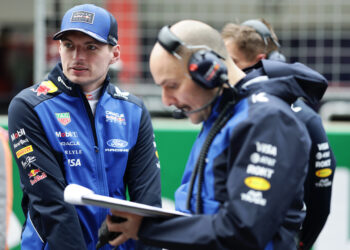
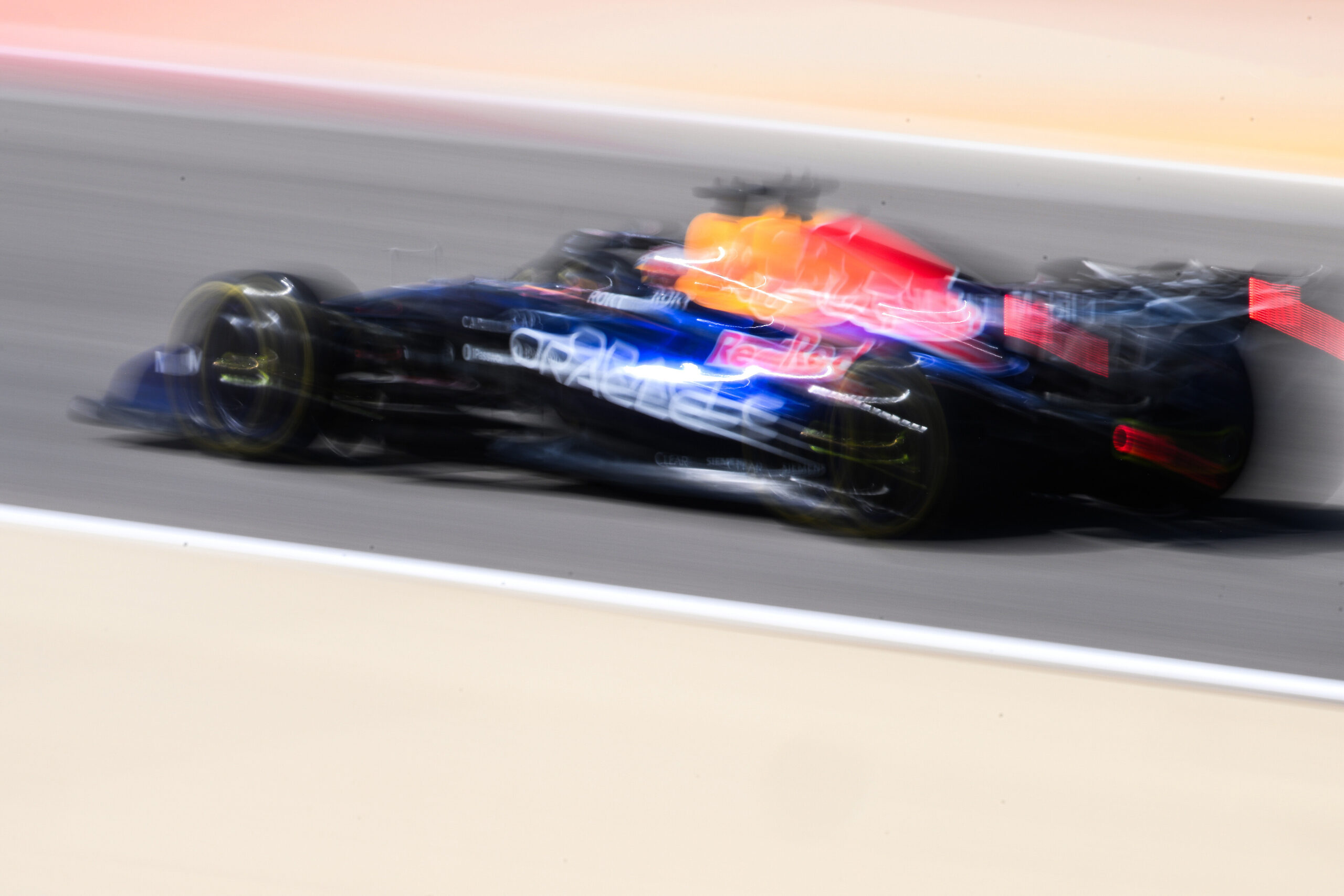
Verstappen’s presence was felt throughout the day in a way that Isack Hadjar’s truncated running on Wednesday simply could not deliver. With an aggressive package of upgrades strapped to the RB22, the four-time world champion worked methodically through a busy programme, setting competitive times throughout and improving in the afternoon as the session developed.
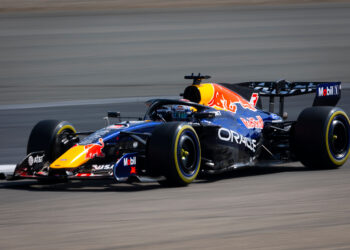
Red Bull’s upgrade list for this second test was substantial. The most visually dramatic change was to the sidepod and engine cover department, which received a wholesale rethink. The original RB22 sidepod concept was relatively restrained; the new version features a far deeper undercut, with the inlet size, shape, and position all adjusted, and a taper toward the rear of the assembly that replaces the earlier downwash ramp. The cooling outlet architecture was also modified, and the team added winglets to the side of the airbox, bringing them into line with several of their rivals who had adopted this feature earlier. The front wing also received a new geometry, with a scooped central section and a mainplane profile that sweeps upward in certain areas to manage pitch sensitivity, particularly important given the transitional aerodynamic loads during active aero deployment. The rear crash structure received an extended winglet, and there were further modifications to the diffuser.
In the afternoon, Verstappen moved to the top of the timesheets on prototype Pirelli rubber with a 1:33.444s before improving to a 1:33.162s on the C3 compound. That left him third overall for the day behind Antonelli and Piastri, a result that paints a broadly positive picture for Red Bull, even if their approach of running a single driver for each day of both tests necessarily limits the overall mileage count compared to teams splitting duties more evenly.
Verstappen’s criticism of the 2026 regulations has been well-documented in the past week and has generated considerable debate in the paddock, with Norris even suggesting the Dutchman could “retire if he wants to” if he found the new rules so unpalatable. Whatever his personal reservations about the direction of the sport, Verstappen, the racing driver, appeared committed and engaged on Thursday, which is ultimately all that matters when the season begins.
Oscar Piastri took over the MCL40 from Norris in the afternoon and produced a fine 1:32.861s, quick enough for second place overall and demonstrating that McLaren’s one-lap pace remains very much in the mix. The Australian, hungry for redemption after losing the 2025 title to Norris in difficult circumstances, worked through a race simulation in the afternoon before a minor incident saw him pull off down an escape road at Turn 1 late in the session, though this did not appear to be a serious technical issue.
The more significant McLaren story of the day came from Norris’s own candid assessment in the post-morning press conference. Asked whether McLaren had been able to transfer the formidable race-pace advantage that defined the MCL39 in 2025 across to the new car, Norris was refreshingly honest. He confirmed that at present the answer is no. The 2025 McLaren was capable of managing tyres so effectively that it could run at a controlled pace for long stints and still pull away; the MCL40 currently requires more effort from the driver to match rival pace on long runs, which in turn increases tyre degradation.
This is a genuinely important admission. Long-run strength was the cornerstone of McLaren’s dominance in 2025 and the foundation upon which both the constructors’ and drivers’ championships were built. If that advantage has not transferred to the new era, McLaren begins 2026 in a more vulnerable position than headline qualifying times might suggest. Norris was careful to note that new parts had arrived in Bahrain for this test and that understanding of the MCL40 was improving, but his tone was far from the quiet confidence of a champion who knows he has the fastest car. It is a flag worth watching heading into Melbourne.
If any narrative from this week’s testing risks becoming tedious through sheer repetition, it is the chronicle of Aston Martin’s reliability woes. Fernando Alonso, who took on the full day of running for the Silverstone-based team on Thursday, managed 40 laps in the morning session before a Honda power unit issue forced the car to stop on track in the afternoon, the AMR26 grinding to a halt on the exit of Turn 4, triggering a red flag. Alonso completed 68 laps across the entire day, a respectable enough number in isolation but far short of what the team needed given the relentless mechanical interruptions they have suffered since the moment pre-season testing began.
It was the second consecutive day that an Aston Martin had triggered a red flag at this test. On Wednesday, Lance Stroll’s car suffered a technical fault that caused a strange spin under braking, beaching the AMR26 in the gravel at Turn 11 during the afternoon session. Back-to-back days of red flag incidents from the same team are an uncomfortable pattern, and what makes it worse is the context: Aston Martin has barely been able to complete a clean, representative programme across either Bahrain test, meaning they arrive in Melbourne with less data, less tyre understanding, and less confidence in their package than any other team on the grid.
Alonso described the situation with the measured composure of a man who has been through enough pre-seasons to know that panicking serves no purpose, but his words carried an unmistakable weight. The two-time world champion confirmed that Honda had identified a power unit issue that required the car to be stopped out on track as a precaution, and that the team would not return to the circuit that afternoon. He acknowledged that there were many things that needed to be fixed, while expressing confidence that the team and Honda were working at full capacity to address them.
Stroll’s assessment from the first Bahrain test, where he suggested the AMR26 could be as many as four seconds off the pace, has cast a long shadow. Alonso has been more diplomatically measured in his public comments, and in fairness, four seconds of deficit in pre-season testing cannot be taken entirely at face value. But the combination of significant pace deficit and persistent reliability failures is a uniquely damaging pre-season problem. You can fix either in isolation, but fixing both simultaneously in the three weeks before Melbourne is an enormous challenge.
The AMR26 represents an ambitious design on multiple fronts. It is Aston Martin’s first car built with Adrian Newey’s input after the legendary designer joined from Red Bull, and it incorporates the team’s first in-house gearbox, built as part of their drive towards greater technical self-sufficiency. Both of those elements, the complexity of a Newey-influenced aerodynamic concept and the introduction of a bespoke transmission, are areas where teething troubles are entirely plausible. But plausible explanations provide cold comfort when you are watching your car being recovered under a red flag for the second day running, and when your closest rivals are racking up hundreds of clean laps around you.
Standing back from the granular detail of Thursday’s running, a broader competitive hierarchy is beginning to take shape, even with all the familiar caveats about fuel loads, tyre compounds, and the fact that teams are not necessarily showing their full hand before Melbourne.
Mercedes appears to be in the strongest overall position heading into the 2026 season opener. Their pace across both Bahrain tests has been consistently impressive, their mileage has been high, and Antonelli’s best time of the entire fortnight suggests there is genuine performance in the W17. The team’s approach has been methodical and productive, and they face the additional strategic complication that their engine is believed by many rivals to be the most powerful on the grid, which creates a difficult dynamic in terms of what they choose to show before Australia.
Ferrari looks genuinely exciting for the first time in several years. After a dismal 2025 campaign in which they failed to win a single grand prix, the SF-26 appears to offer serious performance, creative engineering, and a driver in Hamilton who is newly motivated and settling into the car with increasing confidence. The flip-wing concept, if it proves reliable and legal, could be a significant competitive differentiator. The practice start performance is another area of promise. There are questions about reliability to resolve, but the fundamental direction of the team looks encouraging.
Red Bull’s comprehensive upgrade package suggests they remain serious contenders, and Verstappen, on a fully productive day, was able to mix it convincingly at the front. The combination of a reworked aerodynamic package and a power unit that Toto Wolff himself described as setting a benchmark in the first Bahrain test is a formidable proposition.
McLaren’s admission that their long-run pace edge has not survived the regulatory transition is the most significant uncertainty of the week. On a single lap, they remain competitive, but if race pace is the limiting factor, it could fundamentally alter their trajectory compared to 2025.
Valtteri Bottas completed only a handful of installation laps in the morning session before the Cadillac team made further adjustments, bringing his overall mileage for the day into very modest territory. The American team, entering Formula 1 for the first time, continues to operate in learning mode. Their approach of treating these tests as genuine data-gathering exercises rather than lap time competitions is entirely sensible for a new entrant, but there will be a sharp reality check when the lights go out in Melbourne.
Audi’s programme has been similarly restricted by the kinds of issues you would expect from a brand-new works operation. The team was the first in the field to complete a shakedown with a 2026-spec car, which in some respects speaks to the ambition of the project, but translating that ambition into reliable, consistent testing output has proved challenging. Like Cadillac, the long game is what matters here, and Adrian Newey’s influence on the grid extends to more than just Aston Martin, with Audi’s own structural rebuilding having attracted significant technical investment. Thursday was not a day of glory for either new entrant, but the pre-season is not where their stories will be written.
With the last day of pre-season testing, Friday, February 20, all that stands between the paddock and Melbourne, every team will be trying to extract maximum value from the remaining hours in Sakhir. For Aston Martin, it is an almost desperate final opportunity to build some confidence and mileage. For Ferrari, the key question is whether the flip-wing returns to the car in a more settled form, or whether it is parked until the engineering team has drawn its conclusions from Thursday’s brief but revealing data.
Red Bull will continue to develop their understanding of the upgraded RB22 package. McLaren will want their drivers to work through long-run simulations and understand whether Norris’s concerns about race pace have genuine solutions in the immediate term, or whether this is a challenge that will take several race weekends to address.
One thing is certain: the 2026 season promises to be genuinely unpredictable. The combination of radically new chassis regulations, significantly revised power unit architecture, active aerodynamics that are only beginning to be fully exploited, and a competitive field in which the margins between the front-runners are genuinely close, sets the stage for a campaign that could reset the established order. Ferrari is genuinely in the conversation for the first time in years. Mercedes appears to have built something fast. Red Bull remains dangerous. McLaren is the defending champion but is openly questioning whether their strengths have survived the transition.
In a sport that has become somewhat accustomed to predictability, Day 2 of the final Bahrain test was a reminder that genuine uncertainty is the most compelling product Formula 1 can offer. And on the evidence of a day that gave us an upside-down wing, a new fastest lap, and a renewed sense that nobody really knows what will happen in Melbourne, the sport appears to be delivering exactly that.